
Sok: dex with amm protocols
Summary of SoK: DEX with AMM Protocols
SoK: systematization of knowledge
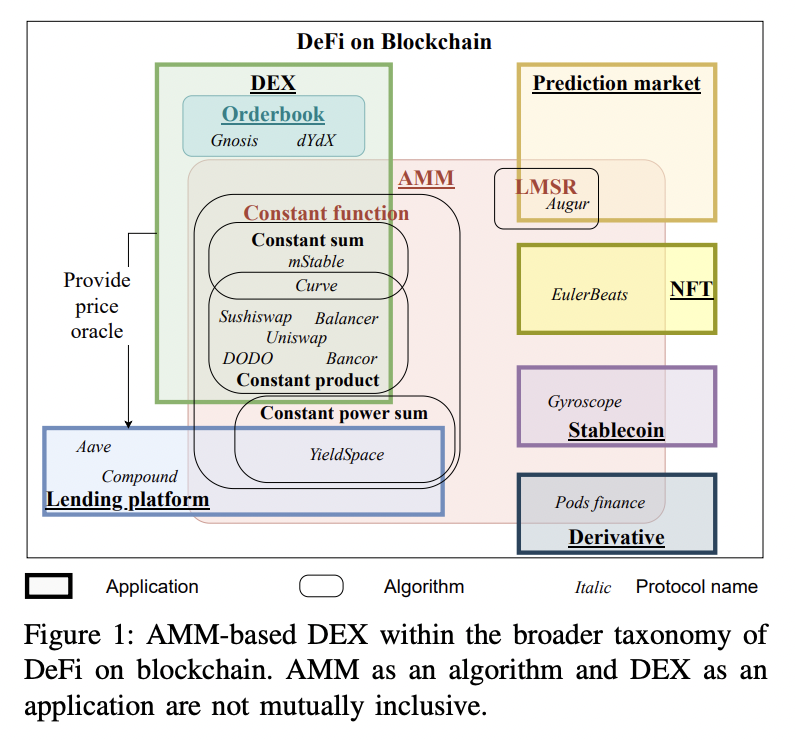
AMM
Pros: Provides liquidity and encourage swapping assets
Cons: Slippage will easily occur. vulnerable to impermanent loss(divergence loss). Also has security issue
A lot of models were proposed to solve this issue, but there were mostly just the same.
The purpose of this paper is SoK of AMM-based DEX
Actors
- Liquidity Providers
- Traders
- Protocol Foundation
Assets
- Risk assets
- Illiquidity, type of assets the DEX is designed for
- Base assets
- In some protocols, risk assets have to be designated with base assets
- Pool shares
- Liquidity shares, LP shares. Represents ownership in the portfolio of the assets within a pool
- Protocol tokens
- Governance token.
Dynamics
- Invariant properties
- conservation function. ex) CPMM
- Mechanisms
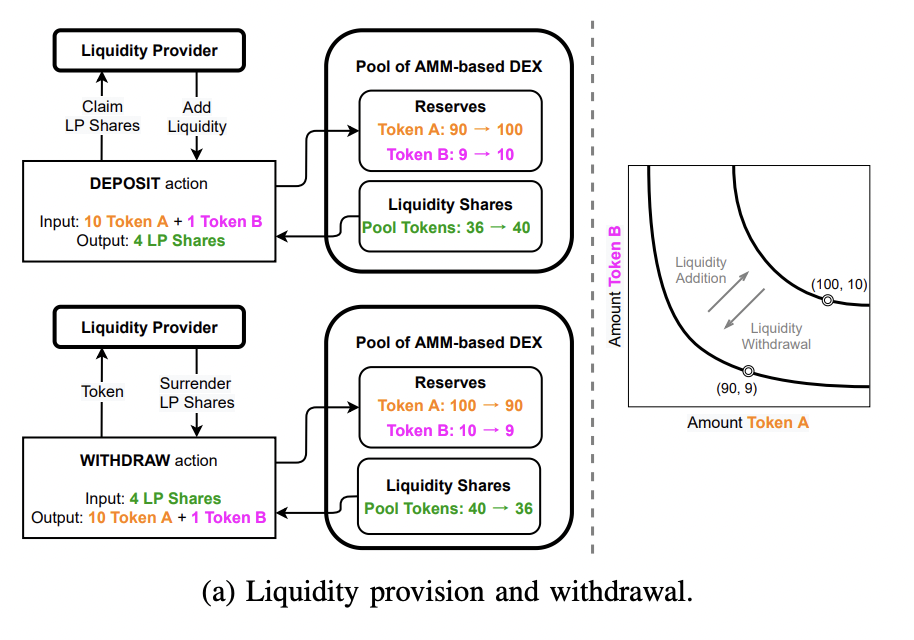
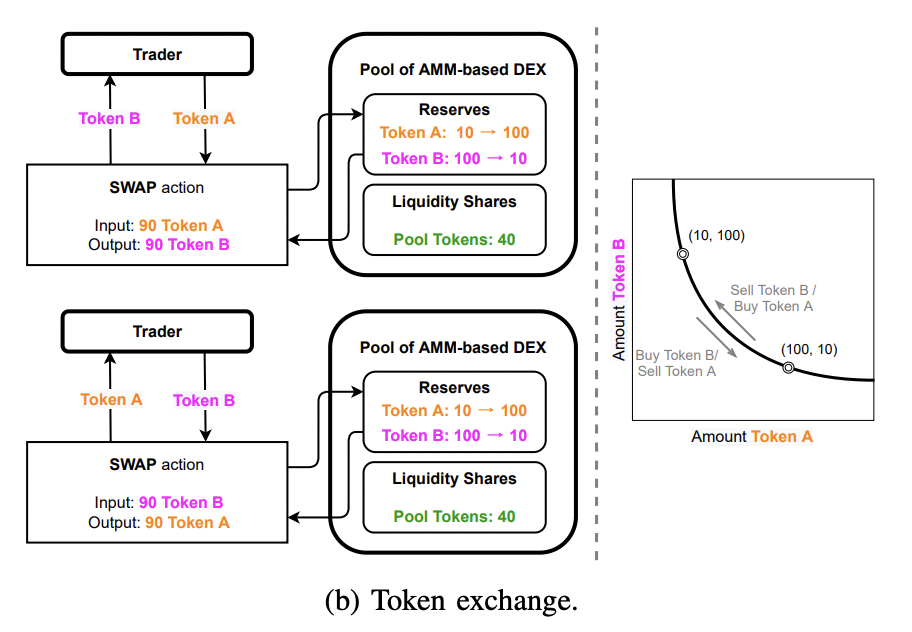
- asset swapping & liquidity provision/withdrawls
Economy
- Rewards
- Liquidity reward - Receive trading fees
- Staking reward - Rewards from staking pool shares or other tokens as part of an initial incentive program from a certain token protocol
- Governance right - rights to vote for proposals
- Security reward - bounty programs, auditing, etc.
- Explicit cost
- Liquidity withdrawal penalty
- Swap fee
- Gas fee
- Implicit cost
- Slippage
- Divergence loss(Impermenant loss)
State space representation
state \(\chi\)
\(\chi = ({\{r_k\}_{k=1,...,n}, \{p_k\}_{k=1,...,n}, C, \Omega})\)
\(r_k = quantity\ of\ token\ k\)
\(p_k = current\ spot\ price\ of\ token\ k\)
\(C = conservation\ function\ invariants\)
\(\Omega = collection\ of\ protocol\ hyperparameters\)
General rules of AMM-based DEX
- Price stays constant for pure liquidity provision and withdrawals
- Invariants of AMM pool stays constant for pure swapping
\((\{r_k\}, \{p_k\}, \mathcal{C}, \Omega) \xrightarrow{liquidity\ change} (\{r_k\}, \{p_k\}, \mathcal{C}', \Omega)\)
\((\{r_k\}, \{p_k\}, \mathcal{C}, \Omega) \xrightarrow{swap} (\{r_k'\}, \{p_k'\}, \mathcal{C}, \Omega)\)
- Cisproportionate addition or removal can be viewed as combination of proportionate reserve change plus asset swap
- Swap fees causes \(\mathcal{C}\) to change. It can be divided into swap and provision
Generalized formulas
- Conservation function (bonding curve)
\(\mathcal{C} = C(\{r_k\})\)
conservation function for each token \((r_i - r_o)\) must be concave, nonnegative, nondecreasing
\(Z(\{r_k\};\mathcal{C}) = C(\{r_k\}) - \mathcal{C} = 0\)
here, \(\mathcal{C}\) is determined by initial liquidity provision.
For example, if AMM formula is \(XY = k\), then \(Z = XY - k,\ C(\{r_k\}) = XY,\ \mathcal{C} = k\) - Spot exchange rate
\(_iE_o(\{r_k\}; \mathcal{C}) = \dfrac{\partial Z(\{r_k\};\mathcal{C})/r_o}{\partial Z(\{r_k\};\mathcal{C})/r_i}\) -
Swap amount input \(x_i\), output \(x_o\)
a) Update reserve quantities
\(r_i':=R_i(x_i;r_i) = r_i + x_i\)
\(r_j' = r_j \ \forall j \neq i,o\)b) Compute new reserve quntity of token o
\(r_o' = R_o(x_i, \{r_k\}; \mathcal{C}) \Leftrightarrow Solving\ Z=0\)c) Compute swapped quntity
\(x_o := X_o(x_i, \{r_k\}; \mathcal{C}) = r_o - r_o'\) - Slippage \(S(x_i, \{r_k\}; \mathcal{C}) = \dfrac{x_i/x_o}{_iE_o} - 1\)
-
Divergence loss
value of token \(o\) is increased by \(\rho\) while others stay the same
token \(_i\) is a numeraire.
a) Calculate the original pool value
\(V(\{r_k\}; \mathcal{C}) = \sum_j{_iE_o(\{r_k\}; \mathcal{C}) \cdot r_j }\)b) Calculate the reserve value if held outside of the pool
\(V_{held}(\rho; \{r_k\}, \mathcal{C}) = V(\{r_k\}; \mathcal{C}) + [_iE_o(\{r_k\}; \mathcal{C}) \cdot r_o] \cdot \rho\)c) Obtain re-balanced reserve quantities
\(\rho = \dfrac{_jE_o(\{r_k'\};\mathcal{C})}{_jE_o(\{r_k\};\mathcal{C})} -1\)
\(Z(\{r_k'\};\mathcal{C}) = 0\)
\(r_k' = R_k(\rho,\{r_k\};\mathcal{C})\)d) Calculate the new pool value
\(V'(\rho,\{r_k'\}; \mathcal{C}) = \sum_j{_iE_j(\{r_k'\};\mathcal{C}) \cdot r_j'}\)e) Calculate the divergence loss
\(L(\rho, \{r_k'\}; \mathcal{C}) = \dfrac{V'(\rho, \{r_k'\}; \mathcal{C})}{V_{held}'(\rho, \{r_k'\}; \mathcal{C})} -1\)
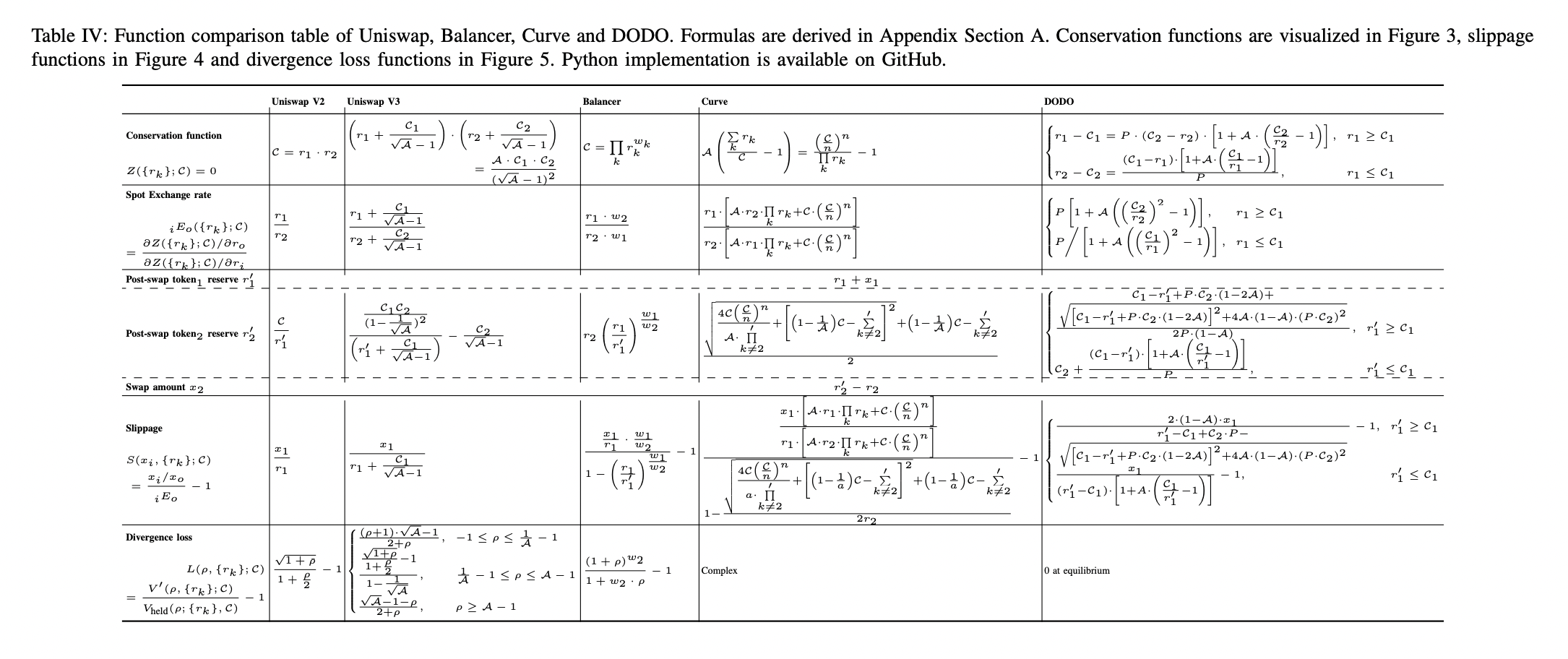
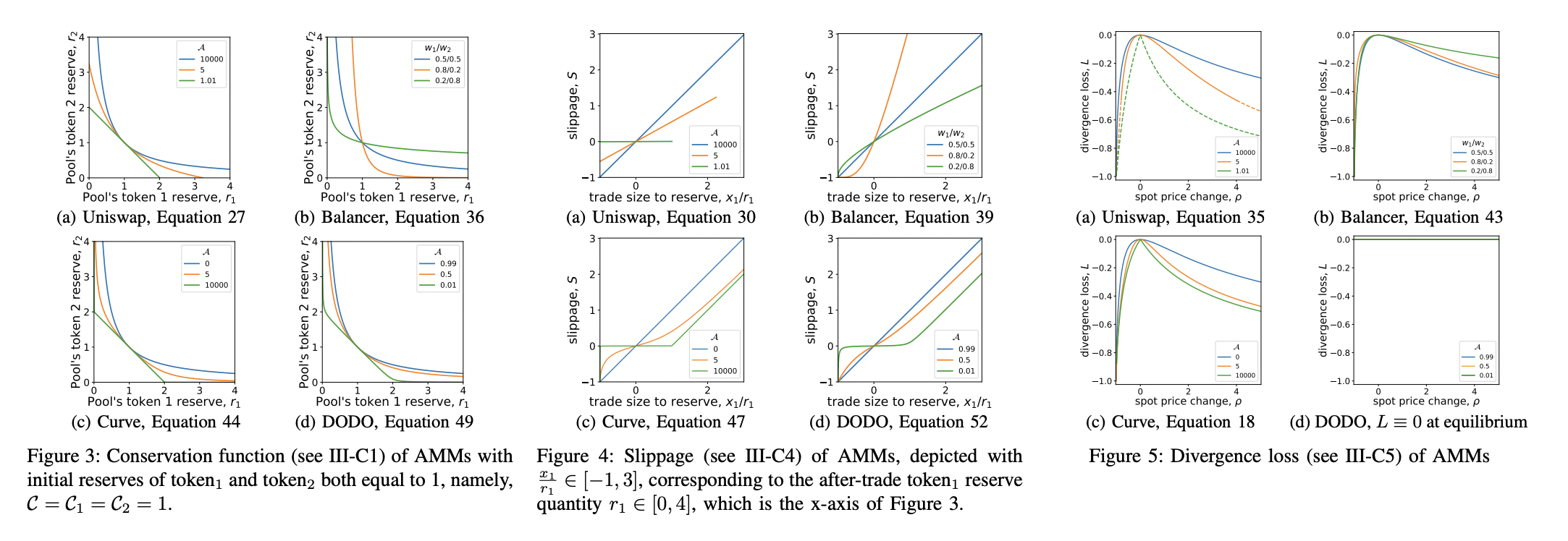
Formulas of major AMM-based Dex
Uniswap V2
a) Conservation function
\(\mathcal{C} = r_1 \cdot r_2\)
b) Spot exchange rate
\(_1E_2 = \dfrac{r_1}{r_2}\)
c) Swap amount
\(r_1' = r_1 + x_1\)
\(r_2' = \dfrac{\mathcal{C}}{r_1'}\)
\(x_2 = r_2 - r_2'\)
d) Slippage
\(S(x_1) = \dfrac{x_1/x_2}{_1E_2} -1 = \dfrac{x_1}{r_1}\)
e) Divergence loss
\(\dfrac{V}{2} = V_1 = V_2 = r_1\)
\(V_{held} = V + V_2 \cdot \rho = r_1 \cdot (2 + \rho)\)
\(\dfrac{V'}{2} = V_1' = V_2' = r_1' = r_1 \cdot \sqrt{1 + \rho}\)
Note that \(r_2' = \dfrac{r_2}{\sqrt{1 + \rho}}\) and \(p' = \dfrac{(1 + \rho)r_1}{r_2}\)
\(L(\rho) = \dfrac{V'}{V_{held}}-1 = \dfrac{\sqrt{1 + \rho}}{1 + \dfrac{\rho}{2}}-1\)
Uniswap V3
a) Conservation function
Suppose a user supplies \(\mathcal{C_1}\) token 1 and \(\mathcal{C_2}\) token 2
His liquidity is only provided for swapping within a specific range of exchange rates: \([\dfrac{\mathcal{C_1}}{\mathcal{C_2}\mathcal{A}}, \dfrac{\mathcal{C_1}\mathcal{A}}{\mathcal{C_2}}]\) where \(\mathcal{A} > 1\) and initial exchange rate is \(\dfrac{\mathcal{C_1}}{\mathcal{C_2}}\)
\(r_1^{equiv} = \dfrac{\mathcal{C_1}}{1-\dfrac{1}{\sqrt{\mathcal{A}}}}\ and\ r_2^{equiv} = \dfrac{\mathcal{C_2}}{1-\dfrac{1}{\sqrt{\mathcal{A}}}}\)
Conservation function looks like this:
\([r_1 + (r_1^{equiv} - \mathcal{C_1})] \cdot [r_2 + (r_2^{equiv} - \mathcal{C_2})] = r_1^{equiv} \cdot r_2^{equiv}\)
\((r_1 + \dfrac{\mathcal{C_1}}{\sqrt{\mathcal{A}}-1}) \cdot (r_2 + \dfrac{\mathcal{C_2}}{\sqrt{\mathcal{A}}-1}) = \dfrac{\mathcal{A} \cdot \mathcal{C_1} \cdot \mathcal{C_2}}{(\sqrt{\mathcal{A}}-1)^2}\)
b) Exchange rate
\(_1E_2 = \dfrac{r_1 + \dfrac{\mathcal{C_1}}{\sqrt{\mathcal{A}}-1}}{r_2 + \dfrac{\mathcal{C_2}}{\sqrt{\mathcal{A}}-1}}\)
c) Swap amount
\(r_1' = r_1 + x_1\)
\(r_2' = \dfrac{\mathcal{C_1}\mathcal{C_2}}{(1-\dfrac{1}{\sqrt{\mathcal{A}}})^2} / (r_1' + \dfrac{C_1}{\sqrt{\mathcal{A}}-1}) - \dfrac{\mathcal{C_2}}{\sqrt{\mathcal{A}}-1}\)
\(x_2' = r_2 - r_2'\)
d) Slippage
\(S(x_1) = \dfrac{x_1/x_2}{_1E_2} -1 = \dfrac{x_1}{r_1 + \dfrac{\mathcal{C_1}}{\sqrt{\mathcal{A}}-1}}\)
e) Divergence loss
\[L(\rho) = \dfrac{V'}{V_{held}}-1 \\ = \begin{cases} \dfrac{(\rho +1 ) \cdot \sqrt{\mathcal{A}}-1}{2+\rho},&-1 \le \rho \le \dfrac{1}{\mathcal{A}}-1 \\ \dfrac{\dfrac{\sqrt{1+\rho}}{1+\dfrac{\rho}{2}}-1}{1-\dfrac{1}{\sqrt{\mathcal{A}}}}, & \dfrac{1}{\mathcal{A}} -1 \le \rho \le \mathcal{A}-1 \\ \dfrac{\sqrt{\mathcal{A}}-1-\rho}{2+\rho}, & \rho \ge \mathcal{A}-1 \end{cases}\]Balancer
a) Conservation function
\(\prod_k r_k^{w_k}\)
b) Spot exchange rate
\(_1E_2 = \dfrac{r_1 \cdot w_2}{r_2 \cdot w_1}\)
c) Swap amount
\(r_1' = r_1 + x_1\)
\(r_2' = r_2(\dfrac{r_1}{r_1'})^{\dfrac{w_1}{w_2}}\)
\(x_2 = r_2 - r_2'\)
d) Slippage
\(S(x_1) = \dfrac{x_1/x_2}{_1E_2} -1 = \dfrac{\dfrac{x_1}{r_1} \cdot \dfrac{w_1}{w_2}}{1 - (\dfrac{r_1}{r_1'})^{\dfrac{w_1}{w_2}}}-1\)
e) Divergence loss
\(V = \dfrac{V_1}{w_1} = \dfrac{V_2}{w_2} = \dfrac{V_k}{w_k} = \dfrac{r_1}{w_1}\)
\(V_{held} = V + V_2 \cdot \rho = V \cdot(1 + w_2 \cdot \rho)\)
\(V' = \dfrac{V_1'}{w_1} = \dfrac{r_1'}{w_1} = \dfrac{r_1 \cdot (1 + \rho)^{w_2}}{w_1} = V \cdot (1 + \rho)^{w_2}\)
\(L(\rho) = \dfrac{V'}{V_{held}} -1 = \dfrac{(1+\rho)^{w_2}}{1 + w_2 \cdot \rho} -1\)
Curve
a) Conservation function
\(A(\dfrac{\sum_k r_k}{\mathcal{C}} -1) = \dfrac{(\dfrac{\mathcal{C}}{n})^n}{\prod_k r_k} -1\)
b) Spot exchange rate
\(Z(r_1, r_2) = \dfrac{(\dfrac{\mathcal{C}}{n})^n}{r_1r_2\prod_{k\ne1,2} r_k} -1 -\mathcal{A}(\dfrac{r_1 + r_2 + \sum_{k\ne1,2} r_k}{\mathcal{C}}-1)\)
\(_1E_2 = \dfrac{\partial Z(r_1, r_2) / \partial r_2}{\partial Z(r_1, r_2) / \partial(r_1)} = \dfrac{r_1 \cdot [\mathcal{A}\cdot r_2 \cdot \prod_k r_k + \mathcal{C} \cdot (\dfrac{\mathcal{C}}{n})^n]}{r_2 \cdot [\mathcal{A}\cdot r_1 \cdot \prod_k r_k + \mathcal{C} \cdot (\dfrac{\mathcal{C}}{n})^n]}\)
c) Swap amount
\(r_1' = r_1 + x_1\)
\(r_2' = \dfrac{\sqrt{\dfrac{4\mathcal{C}(\dfrac{C}{n})^n}{\mathcal{A} \cdot \prod_{k \ne 2}^{'}} + [(1 - \dfrac{1}{\mathcal{A}})\mathcal{C} - \sum_{k \ne 2}^{'}]^2} + (1 - \dfrac{1}{\mathcal{A}})\mathcal{C} - \sum_{k \ne 2}^{'}}{2}\)
\(x_2 = r_2 - r_2'\)
where \(\prod_{k \ne 2}^{'} = r_1' \cdot \prod_{k \ne 1,2} r_k \:\) and \(\sum_{k \ne 1,2}^{'} = r_1' + \sum_{k \ne 1,2}r_k\)
d) Slippage
\[S(x_1) = \dfrac{x_1 / x_2}{_1E_2} -1 \\ = \dfrac{\dfrac{x_1 \cdot [\mathcal{A} \cdot r_1 \prod_k r_k + \mathcal{C} \cdot (\dfrac{\mathcal{C}}{n})^n]}{r_1 \cdot [\mathcal{A} \cdot r_2 \prod_k r_k + \mathcal{C} \cdot (\dfrac{\mathcal{C}}{n})^n]}}{1 - \dfrac{\sqrt{\dfrac{4\mathcal{C}(\dfrac{\mathcal{C}}{n})^n}{a\cdot\prod_{k\ne 2}^{'}} + [(1 - \dfrac{1}{a})\mathcal{C - \sum_{k \ne 2}^{'}}]^2}+ (1 - \dfrac{1}{a})\mathcal{C} - \sum_{k \ne 2}^{'}}{2r_2}}\]DODO
a) Spot exchange rate
b) Conservation function
\[r_1 - \mathcal{C_1} = \int_{r_2}^{\mathcal{C_2}}P[1+\mathcal{A}((\dfrac{\mathcal{C_2}}{\delta})^2 -1)]d\delta \\ = P \cdot (\mathcal{C_2} - r_2) \cdot [1 + \mathcal{A} \cdot (\dfrac{\mathcal{C_2}}{r_2}-1)], \,\: r_1 \ge \mathcal{C_1}\] \[r_2 - \mathcal{C_2} = \int_{r_1}^{\mathcal{C_1}}\dfrac{1+\mathcal{A}((\dfrac{\mathcal{C_1}}{\delta})^2 -1)}{P}d\delta \\ = \dfrac{(\mathcal{C_1} - r_1) \cdot [1 + \mathcal{A} \cdot (\dfrac{\mathcal{C_1}}{r_1}-1)]}{P}, \,\: r_1 \le \mathcal{C_1}\]c) Swap amount
\(r_1' = r_1 + x_1\)
d) Slippage
\[S(x_1) = \begin{cases} \dfrac{2 \cdot (1 - \mathcal{A} \cdot x_1)}{r_1' - \mathcal{C_1} + \mathcal{C_2} \cdot P - \sqrt{[\mathcal{C_1}-r_1'+P\cdot \mathcal{C_2} \cdot (1 - 2\mathcal{A})]^2 + 4\mathcal{A} \cdot (1 - \mathcal{A}) \cdot (P \cdot \mathcal{C_2})^2} } -1, & r_1' \ge \mathcal{C_1} \\ \dfrac{x_1}{(r_1' - \mathcal{C_1}) \cdot [1 + \mathcal{A} \cdot (\dfrac{\mathcal{C_1}}{r_1'} -1)]} -1, & r_1' \le \mathcal{C_1} \end{cases}\]